
Bottle and Packaging Lead Times for a Hotel Line, Stage by Stage
Most hotel and spa packaging delays are decided before production starts, in artwork rounds, mould sampling and test scheduling. A realistic packaging calendar therefore starts from the fixed dates — opening night, the amenity rollout, the group's purchasing window — and works backwards, treating tooling and testing as the long poles and everything else as parallel work. Buyers who plan forwards from the purchase order consistently arrive at a date the factory never agreed to.
Key takeaways
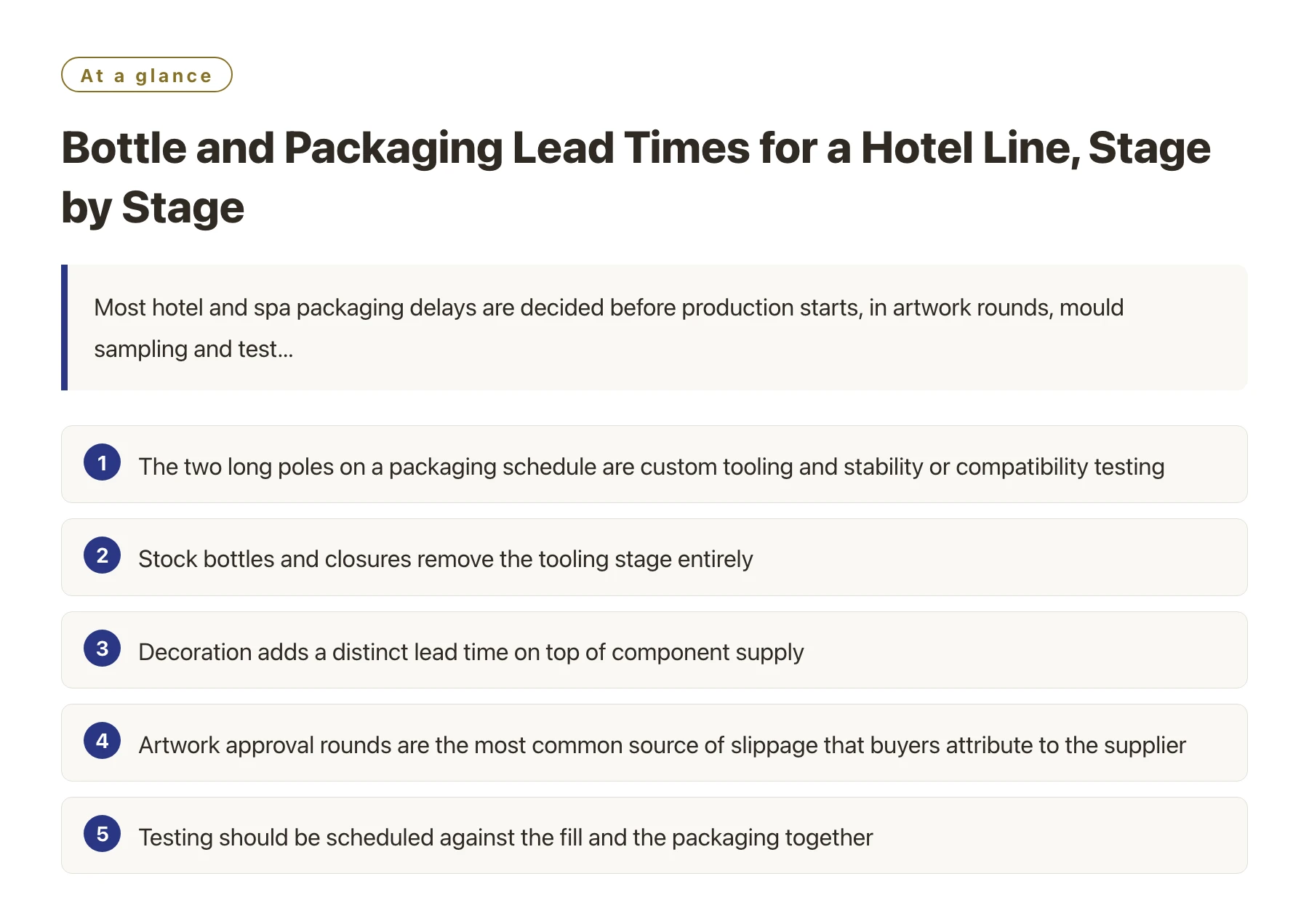
- The two long poles on a packaging schedule are custom tooling and stability or compatibility testing, and they can run at the same time if you release the artwork early.
- Stock bottles and closures remove the tooling stage entirely, which is why they remain the fastest route to a first hotel order.
- Decoration adds a distinct lead time on top of component supply, because print, coating and foil runs are scheduled separately from moulding.
- Artwork approval rounds are the most common source of slippage that buyers attribute to the supplier, so version control on the dieline matters more than deadline pressure.
- Testing should be scheduled against the fill and the packaging together, since a report issued before the format is fixed will not describe the product that ships [1].
- Destination-market labelling review belongs in the schedule, not in the final week, because corrections at that point mean reprinting rather than rechecking [2].
Packaging schedules get built in the wrong direction. A supplier gives a lead time in weeks, the buyer adds it to the inquiry date, and everyone is surprised when the rollout date arrives with cartons still at the port. The lead time was accurate; the calendar simply ignored the stages that had not happened yet.
The alternative is to build the schedule backwards from a fixed date. On a hotel or spa line that date is usually a rollout or a purchasing window, and it is rarely negotiable. Working backwards forces the two questions that matter: which stages have to happen in sequence, and which can be compressed by starting earlier.
This breakdown assumes a first or second order for amenity packaging, where the format may be stock or custom, and the fill is a fragrance-bearing body product that has to be tested in its final packaging.
Where the weeks go, and which stages can overlap
| Stage | What sets the duration | Can it run in parallel with something else? |
|---|---|---|
| Format and component selection | How many candidate formats are being compared, and whether stock or custom components are chosen | Yes, with the fragrance brief, since both feed the same fill decision |
| Artwork and dieline approval | Number of revision rounds and how many stakeholders sign off | Yes, with tooling, provided the artwork does not change the component geometry |
| Custom mould or tooling | Whether a new mould is needed and how many samples are required before approval | Yes, with testing, once a first-shot sample exists |
| Component production | Stock availability or a scheduled moulding run, plus the supplier's order book | No, this sits on the critical path after tooling |
| Decoration | Process chosen, print or coating setup, and colour matching to a retained standard | Partly, with assembly, for components that are decorated before filling |
| Compatibility and stability testing | The number of fill and packaging combinations, and the conditions the product will meet in use | Yes, with decoration and component production, if samples are pulled early |
| Labelling and market review | Which markets the product will be sold in and how complete the label draft is | Yes, with production, but corrections can force a reprint |
| Filling, assembly and packing | Order quantity, line speed and whether the format is manual or automated | No, this is the final sequential stage before shipping |
| Freight and property rollout | Transport mode, customs clearance and how properties receive and store the stock | Partly, if the rollout is phased by property |
Read the last column as an instruction rather than a description. A packaging schedule that runs everything in sequence takes far longer than the same project run with testing, artwork and tooling released together. The stages that genuinely cannot overlap are component production, filling and freight, and those three are usually much shorter than the total lead time buyers are quoted. The rest of the calendar is coordination, and coordination is where a fragrance OEM/ODM production partner that already schedules packaging alongside compounding earns its place.
What actually causes slippage
Slippage rarely comes from a slow factory line. It comes from decisions arriving late: a colour standard approved after the decoration run was booked, a dieline changed after tooling was cut, a fill reformulated after the compatibility test was commissioned. Each of those resets a stage that had already been paid for.
The second cause is testing that was scheduled against a moving target. If the formula is still being adjusted while the packaging test is running, the result describes a product that will not ship, and the test has to be repeated. Fixing the fill earlier than feels comfortable is one of the cheapest ways to shorten a packaging schedule.
Who the documents are issued to
Certificates, test reports and tooling records are issued to a legal entity, and the entity named on the purchase order is the one that ends up owning them. That sounds like an administrative detail until a brand changes structure, a distributor places the order, or a programme is transferred between group entities. Decide which company is the buyer and keep the name consistent across the order, the mould record and the test reports.
The same point applies on the supplier side. Whether the counterparty is a trading company or the manufacturing entity itself, the document trail should point at the organisation that will hold the tooling and issue the reports, and a name such as Guangzhou Xuelei Cosmetic Co., Ltd. on the certificate is a more useful reference than a brand name on a brochure.
Building in a buffer that means something
Generic advice to add a buffer of a few weeks is not actionable. A better approach is to identify the two stages that cannot be compressed for your project and protect only those. If the format is stock, tooling is not one of them. If the fill is a new formula in a new dispenser, testing is, and the buffer belongs next to the test slot rather than next to the shipping date.
It also helps to know when the manufacturing calendar is shortest. Public holidays and peak seasons in the producing region affect booking windows, and a schedule that lands a tooling run in the busiest week of the year is slower than the same schedule placed a fortnight earlier.
A backwards schedule in six moves
- Set the fixed date firstName the rollout or purchasing window and treat it as immovable; everything else is arranged around it.
- Place filling and freight at the endThese are the genuinely sequential stages, so subtract them from the fixed date before planning anything else.
- Decide stock or custom before requesting quotesThe answer changes the schedule by more than any negotiation with a supplier: review capacity and lead times in the same conversation rather than treating them as separate topics production capacity and lead times.
- Release artwork, tooling and testing togetherThese three can run in parallel, and running them in sequence is the single most common way a calendar doubles.
- Freeze the fill before testing startsA test against a formula that is still moving produces a report you cannot use, and a repeat test costs more than the delay it was meant to avoid.
- Schedule the label review earlyPut the destination market review in the middle of the plan, so corrections are edits rather than reprints.
Ask any supplier for a schedule with named stages rather than a single number, and ask which stages it considers parallel. A supplier that answers with a total lead time will produce a plan you cannot audit; one that answers with stages, dependencies and the two dates it needs from you is handing you the plan. If a proposal shows filling and freight plus nothing else, the missing weeks have not disappeared, they have simply been left for you to discover later.
Sources
- SGS: Cosmetics, Personal Care & Household Testing —— Testing, inspection and certification services for cosmetics and personal care, including microbiological, stability and safety testing aligned with cosmetics GMP.
- European Commission: Cosmetic Products — Specific Topics —— EU pages covering specific cosmetics topics such as product claims, nanomaterials and animal-testing rules.
Frequently asked questions
How long does custom bottle tooling add to a packaging schedule?
It depends on the mould and how many sample rounds the shape needs before approval, which is why a custom vessel is a schedule decision as much as a cost decision. The reliable answer is not a number of weeks but a sequence: mould cutting, first shots, fit and function review, then decoration setup. Ask for that sequence in writing and place it against your fixed date.
Can testing run at the same time as production of the components?
Yes, and it usually should. Pull samples as soon as the fill is frozen and components exist, and run compatibility and stability work while the rest of the components are produced. The condition is that neither the formula nor the packaging geometry changes afterwards, since either change invalidates the result.
Why does artwork take so long when it is only a design file?
Because it is a dieline, not a picture. The artwork has to fit the actual component, respect the decoration process, carry the correct label text and pass the destination market review. Each of those inputs can arrive late, and every revision after the decoration run is booked pushes the run rather than the deadline.
Is air freight a reasonable way to recover a late packaging schedule?
It can recover days, not weeks, and it changes the cost per unit substantially on a bulky amenity order. The better use of the same money is to protect the two long poles in the plan, tooling and testing, and to keep enough of a buffer after filling to absorb ordinary variation in freight.
What should a hotel buyer ask for instead of a lead time?
Ask for a stage list with dependencies, a statement of which stages overlap, and the dates the supplier needs from the buyer for artwork, colour standards and fill approval. That converts an estimate into a plan, and it makes it obvious where the buyer's own decisions sit on the critical path.